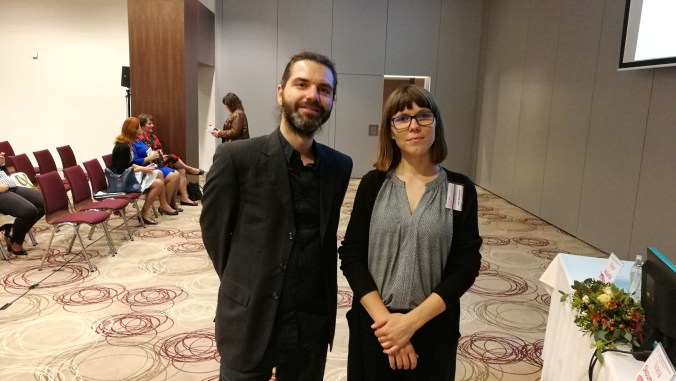
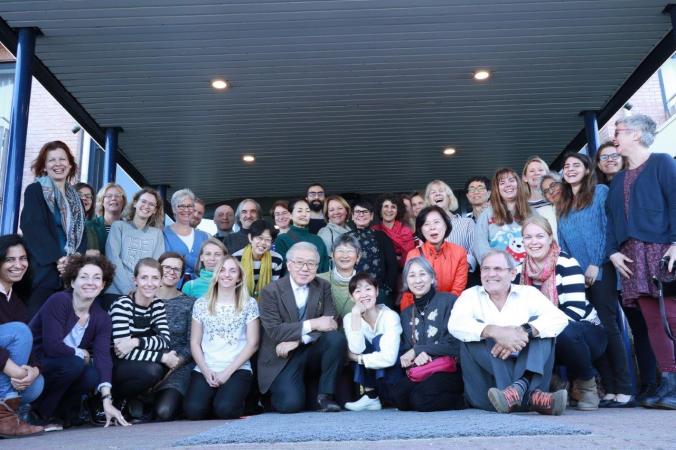
Our colleagues Andrej Belak and Daniela Fiľakovská organised workshop with coordinators of Roma health mediators and management of Healthy regions – organisation of Ministry of Health which runs the health mediation program in Slovakia


Andrej Belak attended on the 9th and 10th of November joint international conference of the Czech and Slovak Associations of Social Anthropologists which took place at the Faculty of Social and Economic Sciences of the Commenius University in Bratislava. In his contribution titled ‘How not to let the vulnerable cooperate on their vulnerabilities?” he presented the Roma health groups’s current applied work.
Our colleagues Ivana Skoumalova a Peter Kolarcik are currently on 8th and 9th of November attending a conference organised by Slovak nephrology association (www.nefro2018.sk) with the lecture and workshop focusing on health literacy and adherence in kidney disease patients.

Our colleagues, prof. Andrea Madarasova Geckova and dr. Lucia Bosakova are currently from 6th till 9th of November attending annual DIPEx International meeting in the island of Ameland, the Netherlands. The meeting covers discussion of topics such as: use of DIPEx for health promotion, education and trainings, methodology and measures improvement, evaluation, data analysis, etc.

Our colleagues Andrej Belak and Daniela Filakovska had on 8th of November appointment at the Public Health Office in Bratislava in order to present our research activities concerning the assessment of health needs in the marginalized Roma communities and negotiate possible cooperation on activities concerning interventions in one of the most complicated localities in Slovakia – Trebisov.
Research proposal on Generation Z submitted to national scientific agency APVV. Fingers crossed as we, together with our colleagues from Bratislava, Brno, Olomouc, Groningen, are eager to join our efforts in exploring GenZers! Our Health Behaviour in School-aged Children data allow us to cover those born in 1995 up to those born in 2010 what is an unique opportunity we do not want to miss.
Our colleague Zuzana Dankulincova as national editor of Slovak version of European Health Psychology Society has recently picked up very interesting blog “What happens with medication when they go home?” by Kerry Chamberlain, Massey University, Auckland, New Zealand available now on Practical Health Psychology
What do people do with medications once they enter the home? Surprisingly, limited research has attempted to answer that question. Yet, it is important – most medications are consumed at home under the control of the consumer. Prescription medicines are regulated, but once prescribed and collected, they are presumed to be taken as directed. People also can access and use a wide range of over-the-counter medications (e.g., for pain relief), alternative medications (e.g., homeopathic preparations), and other health-related preparations that are less obviously medications (e.g., dietary supplements, probiotic drinks). However, we should note that access to all forms of medication can vary considerably between countries.
Our colleagues Jaroslava Mackova and Laura Urbanova are on their study stay at University Medical Center Groningen/University of Groningen, Netherlands since 5th till 16th of November. During the stay they are working on articles connected to HBSC and Care4Youth study as a part of their PhD in the field of adolescent health.
Our colleagues, prof. Andrea Madarasova Geckova and dr. Lucia Bosakova attended on 5th of November 2018 the conference on New Directions in Qualitative Health Research in Groningen, the Netherlands.
The conference took place at the University Medical Center Groningen with the participation of representatives from Australia, USA, UK, Japan, Korea, Israel, Norway, Switzerland, Germany, Spain, the Netherlands and the Czech Republic. Our colleagues had a great opportunity to gain new contacts and deepen their knowledge in participatory action research, online interviews, online focus groups, interviewing children and hard to reach groups as well as analysis of qualitative data.
BMC International Health and Human Rights invites you to submit to our new special issue “Curbing the lifestyle disease pandemic: engaging in transdisciplinary research agenda for effective interventions” edited by Brigit Toebes, Jitse van Dijk, Marlies Hesselman, Jochen Mierau.
In this call for papers, we invite scholars from various health-related disciplines to submit a paper focusing on the identification of concrete solutions to the NCD pandemic. We welcome articles on the scientific evidence concerning behavioural risk factors, the effectiveness of interventions, as well as on the economic, societal, behavioural or demographic dimensions of the debate. Simultaneously, and in response to these scientific outcomes, we invite researchers with a background in international relations, philosophy, law and human rights to reflect on the concrete options for law and policy. To stimulate cross-fertilization between the various disciplines, we encourage researchers to move beyond their own discipline and to engage in a transdisciplinary collaboration with the ultimate aim of identifying effective interventions.
Below are examples of topics which may be addressed:
· Evidence on the effectiveness of tax and other measures to curb the consumption of unhealthy products, and the translation to law and policy.
· Evidence on the effectiveness of regulating risk factors on health outcomes (e.g. the effectiveness of periconceptional, perinatal, and early-life interventions), and the translation to law and policy.
· Evidence on the socio-economic inequalities underlying the NCD pandemic and possible solutions targeting specific vulnerable groups.
· Human rights approaches to socioeconomic inequality and vulnerability in relation to the NCD crisis.
· Evidence on the political processes towards the adoption of laws and policies addressing unhealthy behaviour, as well as legal lifecycle approaches in NCD control.
· Human rights approaches towards risk factors and access to NCD treatment.
· The normative justification of behavioural health measures and possible ethical constraints, such as rights, anti-paternalism and autonomy.
· Questions of fairness and justice in the assessment of the NCD burden and the burdens and benefits associated with measures addressing NCDs.
· The legitimacy of the role of the government in preventive care.
· Solutions for translating effective policies from high-income to low and middle-income countries.
· Approaches for engaging policy-makers and legislators in translating research findings into evidence-based policy and practice.
This collection of articles has not been sponsored and articles undergo the journal’s standard peer-review process overseen by BMC International Health and Human Rights Associate Editor Brigit Toebes and Guest Editors Jitse van Dijk, Marlies Hesselman and Jochen Mierau who declare no competing interests.
Submission is open to everyone. Before submitting your manuscript, please ensure you have carefully read the submission guidelines for BMC International Health and Human Rights.
The deadline for the submission of manuscripts is the 1st December 2018.