Our colleagues Lucia Bosáková, Zuzana Dankulincová and Ivana Skoumalová participated in the annual DIPEx international meeting. From 23 to 26 May, members of the network from around the world discussed their workflow over the past year, the diverse experiences and plans for international cooperation in the years to come. What a wonderful time with inspiring people.
DIPEx International is a unique global collaboration of scientists, physicians and patients who are committed to enriching our understanding of people’s experiences of health, healthcare and disease and bringing this new knowledge to the world.
We are currently participating in an ongoing data collection. The teams located in Bratislava, Martin and Košice set out on a daily basis, ready to visit more than 150 schools, 10000 pupils and travel more than 10000 km across the whole country. We are deeply grateful for each school that is willing to participate, for every respondent and every filled-out questionnaire.
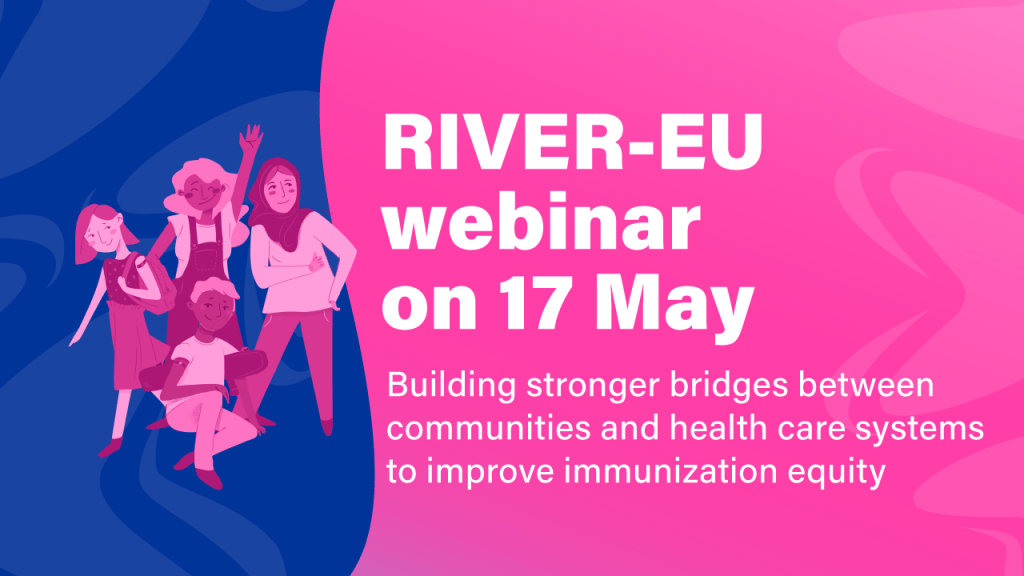
The RIVER-EU project’s (Reducing Inequalities in Vaccine uptake in the European Region – Engaging Underserved communities) European Public Health Week webinar will explore how to build stronger bridges between communities and health care systems to improve immunization equity. Involving communities with low vaccination rates is particularly important to increase trust, accessibility and acceptability of vaccination services and improve overall coverage rates. The RIVER-EU project (2021-2026) works with eight underserved communities across Europe to understand the facilitators and barriers they experience when accessing vaccination services, particularly for measles, mumps, rubella (MMR) and human papillomavirus (HPV) vaccines.
Speakers in this session will share their experiences establishing relationships with the community and discuss promising approaches to address vaccine equity and accessibility which may be transferable from one setting to another.
This event is for anyone involved in community care, especially for those interested in the health and wellbeing of children and adolescents, and underserved ethnic and religious minority communities.
Date: 17 May 2022 Time: 15.00 – 16.00 CET Event type: online
The Arab Israeli community in Israel, Dr. Jumanah Essa-hadad, Bar Ilan University (BIU) Israel
The Ukrainian migrant community in Poland, Prof. Maria Ganczak, Vice-President, Infectious Disease Control Section, EUPHA; Dept of Infectious Diseases, University of Zielona Gora, Poland
The migrant and refugee community in Greece, Mrs. Pania Karnaki, Prolepsis Institute
Turkish and Moroccan adolescent females in the Netherlands, Dr. Janine de Zeeuw, University Medical Center Groningen (UMCG), the Netherlands
The marginalized Roma community in Slovakia, Dr. Daniela Fiľakovská Bobáková, Pavol Jozef Safarik University, Slovakia
15.40 Opening floor for Q&A 15.55 Conclusion 16.00 END
Our new project “Adolescents with emotional and behavioral problems and their families in the system of care”, received financial support from the Slovak Research and Development Agency!
We are looking forward to the opportunity to continue and, after interviews with providers, to conduct interviews with adolescents and their parents using the DIPEx methodology as a new member of DIPEx international.
DIPEx International is a unique global collaboration of scientists, healthcare professionals and patients who are committed to collect people’s experiences of health, healthcare and disease and bringing this new knowledge to the world through qualitative research.
Read a new article on the strategies for the psychological support of the healthcare workforce during the COVID-19 pandemic which was prepared within the collaboration in an international project COST ERNST The European Researcher´s Network working on Second Victims.
Abstract: The COVID-19 pandemic led to the implementation of interventions to provide emotional and psychological support to healthcare workers in many countries. This ecological study aims to describe the strategies implemented in different countries to support healthcare professionals during the outbreak. Data were collected through an online survey about the measures to address the impact of the pandemic on the mental health of healthcare workers. Healthcare professionals, researchers, and academics were invited to respond to the survey. Fifty-six professionals from 35 countries contributed data to this study. Ten countries (28.6%) reported that they did not launch any national interventions. Both developed and developing countries launched similar initiatives. There was no relationship between the existence of any type of initiative in a country with the incidence, lethality, and mortality rates of the country due to COVID-19, and per capita income in 2020. The 24 h hotline for psychological support was the most frequent intervention. Tools for self-rescue by using apps or websites were extensively used, too. Other common interventions were the development of action protocols, availability of regular and updated information, implantation of distance learning systems, early detection of infection programs for professionals, economic reinforcements, hiring of staff reinforcement, and modification of leave and vacation dates.

 COHERENT